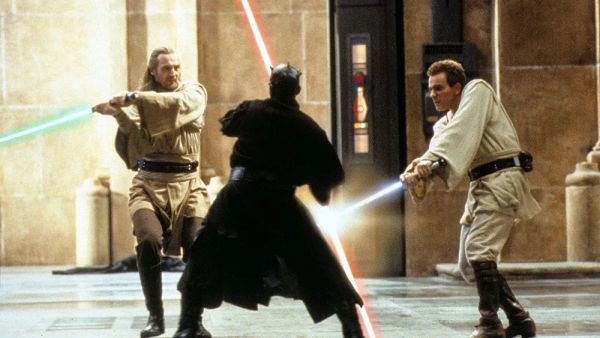
I'm rewatching Star Wars

It's finally time. I've rewatched the Star Wars series a few times, but the main reason this time around is that I want to rewatch Andor with the context of the rest of the films around it. And I also have many, many thoughts about Star Wars (and Lucas and everything surrounding it) that keep banging around in my brain, so blogging about it seems like a good way to set them to rest, at least for a little bit.
This post will largely remain spoiler free and appropriate for Star Wars newbies. Subsequent posts in this series will likely be riddled with spoilers
When?
Well, the holiday season seems like a good time to watch a bunch of films. I won't watch them in a true marathon as that would be impossible to blog along with, but I do plan on watching them back to back.
How?
I'll get into Star Wars fandom briefly in a bit, but there are varying prevailing theories as to how to watch the Star Wars series, which typically limit to just the "Episode" films (not Solo, Rogue One, etc.).
Anyway, one relatively well known sequence for watching the series is the "Machete order", which splices the prequels (Episodes 1-3) between Episode 5 and 6, and often dropping Episode 1. I think this order is largely nonsense, and is even less clean since the sequel trilogy released. I also think that Episode 1's flaws aren't that catastrophic, and the larger world-building is more important.
The best way to watch Star Wars... and the way I'm watching it
There's generally two best ways to watch the series.
If you're new to Star Wars, the best order is to watch the films as they were released. Start with Episodes 4-6, then Episodes 1-3, then 7-9. Don't skip any of the films, even if some of them vary quite drastically in quality. The benefit of this approach is that you get to experience Star Wars the same way as many long-term fans did, experiencing the same twists in the story and living through that universe the same way many fans did. There is a downside to this approach, which is that jumping back from Episode 6 to Episode 1 and then from 3 to 7 makes for a quite disjointed plotline, but I think it's the best way to appreciate Star Wars as a cultural phenomenon, by retracing the same steps fans did.
The second approach, and the one I'll be following this time, is to watch the films in episodic order. This way, you get the straight-through continuation of plot, and more importantly for my run through, I'm intending to insert Andor and Rogue One between Episodes 3 and 4.
What about all the other Star Wars?
Star Wars has a lot more than just the main Episodes, as evidenced by my including the Andor streaming series and the Rogue One film in my watching order. I think pretty much all of the additional content is worth watching, and may add rewatches (or first time watches for some of them) to the series later. Adding them all part way through however, would make it more challenging. As excellent as the Clone Wars animated series is, adding that between Episodes 2 and 3 would take way too long. For your own watching experience, either add them where you think they're appropriate, or save them for some time after the main Episodes
Aside: Why I'm calling the main films "Episodes" (spoilers)
So, the other main name for the Episodes of Star Wars is the "Skywalker Saga", because they centre on the stories of both Anakin and Luke Skywalker. This feels less appropriate a term to describe the sequel trilogy, as aside from the shoehorned reference and self-styling at the end of Episode 9, Rey is not a Skywalker and is clearly the main protaganist of that arc.
Also, arguably most of The Clone Wars would form part of the Skywalker Saga as it heavily features Anakin as a main protaganist throughout
Why I even care about Star Wars
I grew up watching Star Wars since we had the Special Edition VHS boxset in the mid-late 90s. The story was cool, the aliens were cool and interesting, the spaceships were captivating, and like many Star Wars kids I imagined myself having the Force, and being able to reach out for things and fly magically to my hands.
I was also probably still young enough when The Phantom Menace came out to not see it as being "too childish" or some kind of betrayal that gave the film a lot fo scorn from older fans, so I ended up sticking with it. Whilst I found the sequels a little disappointing in comparison, the maybe slightly more than healthy cynicism I've built up over the years has meant I've stuck through the Disney years too, and through every era there's always been stories to tell in the Star Wars universe, and so I keep coming back to it.
But the other thing I've ended up appreciating more and more as I've grown up and also become a bit of a nerd, is how pivotal George Lucas and Star Wars were to modern cinema, and somewhat accidentally, the modern tech world too.
Six Degrees of Lucas
I'm entertaining this notion for fun here mostly, but maybe a bigger post on Lucas' influence is warranted.
One way of demonstrating this is by riffing off a concept known as Six Degrees of Separation, which was itself popularised through "Six Degrees of Kevin Bacon". The Kevin Bacon version lead to the idea of there being a Bacon number, to denote how close someone was connected to this perceived nexus of Holywood.
By expanding the concept a little bit to include "things" rather than just people, we can look at indirect impact and influences. In this case, I'm going to use some loose but fairly well-known examples to illustrate the point, and the steps are going to be fairly loosely/broadly defined, as this is a bigger topic than just this one post. So take this as a fun look at Lucas' surprising impact outside his own field
Example 1: iPhone
iPhone - designed/created by -> Steve Jobs - worked at -> Pixar - split from -> Lucasfilm - created by -> George Lucas
This would give the iPhone a Lucas number of 4. Would the iPhone have ever been made if not for George Lucas and Star Wars? I'm applying this exercise mostly for fun, as the system doesn't really measure how impactful the individual links are on each other. Would Apple have made the iPhone without Steve Jobs? Probably not. Would Steve Jobs ended up at the same place without the stint in Pixar along the way? A lot harder to say.
Example 2: Photoshop
Photoshop - co-created by -> John Knoll - worked at -> ILM - created by -> George Lucas
Photoshop became a fairly ubiquitous photo editing suite under Adobe's ownership, but it was actually originally created by Thomas and John Knoll, the latter of whom worked for ILM. Here the Lucas number is smaller, at 3. Would photoshopping have become a verb without George Lucas? Again, an amusing thought experiment, but in this example despite the closer connection, the Knoll brothers were clearly capable of developing Photoshop without ILM's direct contribution. It's impossible to tell if they'd still have been able to make the deal with Adobe that would turn that company into the powerhouse/stranglehold it still is today had things been different.
The Lucas companies
Star Wars was an ambitious film requiring techniques and technology that didn't exist yet. So it's less surprising his more direct impact is seen through the companies he created to help make the film, with the most notable being the effects house that have pioneered several advances in cinematography, Industrial Light & Magic.
ILM alone has pioneered several cinematography techniques such as motion controlled camera rigs, early full-screen CGI renders, and possibly most recently co-creating StageCraft with Epic Games, to replace bluescreen volumes with real-time in-volume scene rendering. At various points over their history, ILM have significantly changed the toolset available to make films, often directly as a result of trying to make a Star Wars property. ILM have become so prolific that they're a feature in pretty much any blockbuster release or high-budget series that has significant VFX work, even those not made by Disney (who purchased ILM along with the rest of Lucas' businesses in 2012).
THX was also a Lucas creation (in part named after one of Lucas' student film projects), and still exists as a major sound quality standard.
And Skywalker Sounds is not necessarily as well known, but still a prominent film audio house, often making an appearance in Disney features.
Enough waffling, hopefully you've now got an idea of the nonsense I'm trying to get out of my head, I didn't even start on John William's influence (again, this could be its own post).
If for some reason you liked this, come back for more when I get around to my rewatch of Star Wars Episode I: The Phantom Menace