Star Wars - The Phantom Menace
The Saga begins
Before I watch
Phantom Menace was the first Star Wars I saw in cinema (if I remember correctly, at least). As mentioned in my intro post on this "marathon", we had the special edition of the original trilogy on VHS, so it wasn't my first entry into Star Wars, but seeing it on the big screen for the first time will always be special. Also as mentioned in my intro post, if you've not watched Star Wars, there be spoilers ahead. There are quite a few themes in The Phantom Menace I can touch on, and hopefully this rewatch will be a good prompt
 Harley Faggetter
Themes in the film
The opening crawl
Star Wars has become known for starting each film with an opening crawl, with John Williams' Star Wars theme building the anticipation and the text providing world-setting context. In The Phantom Menace, the whole premise of the start of the film is a trade conflict with the Galactic Republic.
"Negotiations"
The Jedi are supposed to be skilled diplomats and able to resolve conflicts peacefully. They are, however, effectively a cult of warrior monks with supernatural abilities and incredibly deadly lightsabers, so whilst not necessarily intended as an affront, their position of ambassadors to the blockade may have suggested a willingness to press the issue with force.
The actual negotiations never really come up in the film. We learn that though there may be some underlying grievance the Trade Federation are pursuing, they're being pushed along by the shadowy presence of Lord Sidious, who is manipulating the situation behind the scenes. Of course, we later learn this is a mere pretense for Palpatine to increase the reach of his power, and eventually take over the Republic and form the Empire. Regardless, you can follow some of this through. Early dialogue suggests that trade franchises can institute blockades legally to resolve trade disputes. Naboo is probably an ideal target for this given the generally pacifist nature of the planet and its current ruler, and apparent lack of criminal underworld that might render a blockade less effective.
Planets as relative monocultures seems to be a theme for Star Wars and it might make sense that in a setting with interstellar travel that individual planets end up gravitating to a singular primary culture with corresponding attributes, however it does paint a picture of Naboo as a fairly pastoral world highly dependent on trade and outside protection, as the planet is shown to be largely wealthy. Even the Gungans, the only notable subculture on Naboo, is composed of large underwater cities that appear general peaceful and prosperous, despite being somewhat isolated by the Naboo.
The Droid Army
The Droid Army of Phantom Menace is surprisingly large for what appears to be a trading group, but the main bulk of the army are bipedal lightweight droids carrying standard firearms. It seems relatively straightforward to believe that these droids started life as utility droids similar to the Pit Droids we see later on Tatooine, that later get repurposed to form generic battalions. The transport vehicles therefore also make sense, whilst carrying a modest armament to protect shipment of their droid cargo. The AAT tanks make a bit less sense, possibly something the Trade Federation stocks for garrison protection on more dangerous planets. We end up seeing not too many of these on the battlefield so perhaps this was a significant commitment from their reserves. The only basic ground unit that's clearly intended for combats are the droidekas (or Destroyer Droids), which come with rapid fire dual laser cannons and shields, but also appear in very limited numbers.
When it comes to the space combat later in the movie, we see the same Droid Starfighter that appears in the very opening scenes, again probably a simple multi-purpose droid that acts as both space defense but also as a extravehicular utility droid for shunting cargo and doing exterior inspections, on account of having manipulable limbs as well as their armament.
The biggest tactical mistake the Trade Federation in this entire occupation is relying on a single command and control point for their droid army to remain online. A mesh network that had command failover and a default operation mode on a complete network collapse would have avoided the embarrassing ending for the Droid Army. This ends up getting rectified by the Trade Federation in later films (though this is mostly implied I guess), in part by apparently offloading some command and control to individual units, and adopting a bit more of a hive mentality.
We also see the Confederacy of Independent Systems (of which the Trade Federation) diversify their forces with more battle-focused droid variants in the later films.
Jar Jar Binks
I always thought Jar Jar got a bad rap as a character. For what's basically a kids movie, he acts as a great comic relief character by being a bit goofy, but also having character development. He's clearly a bit clumsy and oafish, but with a big heart
Amidala and the Handmaidens
For a pacifist civilisation, the amount of effort to engage in ridiculous subterfuge over Queen Amidala's identity is something to behold. The entire conceit seems to be that Queen Amidala always wears heavy makeup, and the handmaidens all look fairly similar to Padmé. In most situations where Amidala is not taking council, she takes the guise of one of her handmaidens and one of her handmaidens takes her place in the Queen's guise.
The guise is used for meaningful effect on two different occasions in the film, but at other times just exists to be a little bit confusing. This is probably the plot point I think adds the least to this particular film, especially given there's no indication Amidala's successor carries on with the nonsensical facade.
The biggest problem with this whole scheme is that Padmé is supposedly Naboo's ruler, but the moment anything is asked of Queen Amidala that she needs to intervene on, her cover's blown. It's really just not that sensible to be using routinely
Tatooine
It's somewhat disappointing how much Star Wars ends up leaning on this one planet, both in the Saga, and in the other series and other media that comes after.
In this case, we're here because it happens to be close enough to Naboo for the Queen's ailing blockade runner, and by chance Qui-Gon and the gang happen upon Anakin in Watto's junk shop.
The whole plot leading up to the podrace is also a bit farcical, but the spectacle of podracing makes up for it
Anakin and Padme
One of the least forgivable aspects of The Phantom Menace was how it handled dialogue between Anakin and Padme. Working with child actors is already difficult, but getting a child actor to play out a crush with an older actor's character with some of the worst dialogue imaginable is, not fun to rewatch. "Are you an angel" makes me cringe every time.
That said, rewatching the Disney+ version, that dialogue seems to have been removed, or I just zoned out for that specific bit. No real loss, as we get the extended podracing scene in this version
The Living Force versus the Cosmic Force, and midichlorians
This only really comes up in a throwaway bit of dialogue at the start, but Phantom Menace introduces the concept of the Living Force, which is a counter to the Cosmic Force. Practitioners of the Living Force like Qui-Gon focus on connection to the Force in the moment. It's not really expanded on much in this movie but does become a recurring topic particularly in the other Star Wars media. The best way I can think of characterising it is that focusing in the moment makes Qui-Gon more aware of his surroundings, more focused on the tangible, but more distant from abilities like clairvoyance, or other abilities that might focus on a detachment from self.
I think this might be why Qui-Gon sees Anakin's high midichlorian count as a strong reason to win his freedom and train him as a Jedi, as a highly tangible connection to the Force would be important to a Living Force practitioner. If I ever rewatch the Clone Wars or Rebel series, there's an arc in both that touches on the nature of the force.
Incidentally, midichlorians are clearly supposed to be analogous to both mitochondria and chloroplasts, symbiotic organelles that exist in animals and plants (the latter being primarily in plants) that developed independently. I've always suspected there was a deeper link he was trying to pull at and express here, and from some reports of what his sequel series would have been, that's what we'd have got more answers to. But we'll deal with the sequels when we get there.
Also, this is the first mention of a Force "vergence", which doesn't come up again until Acolyte, which I feel I need to rewatch and cover at some point, as it hinted at covering what Lucas never got around to, before being received poorly.
Darth Maul
This character is just such a badass from introduction to the end, he deserved. He gets a bit more exploration in further media, but if I get to them I'll cover them again.
Wider thoughts
Politics in Star Wars
The Phantom Menace felt like a more overt attempt by Lucas to make political commentary part of the Star Wars universe, even if the approach is somewhat more heavy-handed and amateur-ish compared to the political intrigue we get much later in Tony Gilroy's Andor.
Even so, elements of the prequel treaty end up kind of echoing the fall of the Weimar Republic, and in more recent years have felt like they also echo in the decline of US hegemony and democracy in the US (and to a lesser extent, the UK too). In a bleak way, this has somewhat heightened my appreciation for the prequels, flaws and all.
New tech
Part of the reason I think Lucas made Star Wars films at all was the opportunity to push the boundaries of the possible, with the Phantom Menace bringing some fully digitally rendered scenes, with a significant number more being a mix of live action with digital effects. The Phantom Menace was a driving force for the adoption of CGI in films, but even then the film still kept a number of practical effects techniques.
Review Summary
Honestly, I still like The Phantom Menace. I don't think it's the best film in the prequel trilogy, nor close to being one of the best Star Wars films, but I appreciate its role in establishing the background of Anakin, and there's no point at which I felt bored. I'm pretty sure there's differences between the Disney+ version and the original home release that are probably in the former's favour, probably this was done when the film was transferred to DVD at some point, or on the BluRay edition, but I'm not going to dig them out for comparisons, and my VHS copy is probably too degraded now to rewatch.
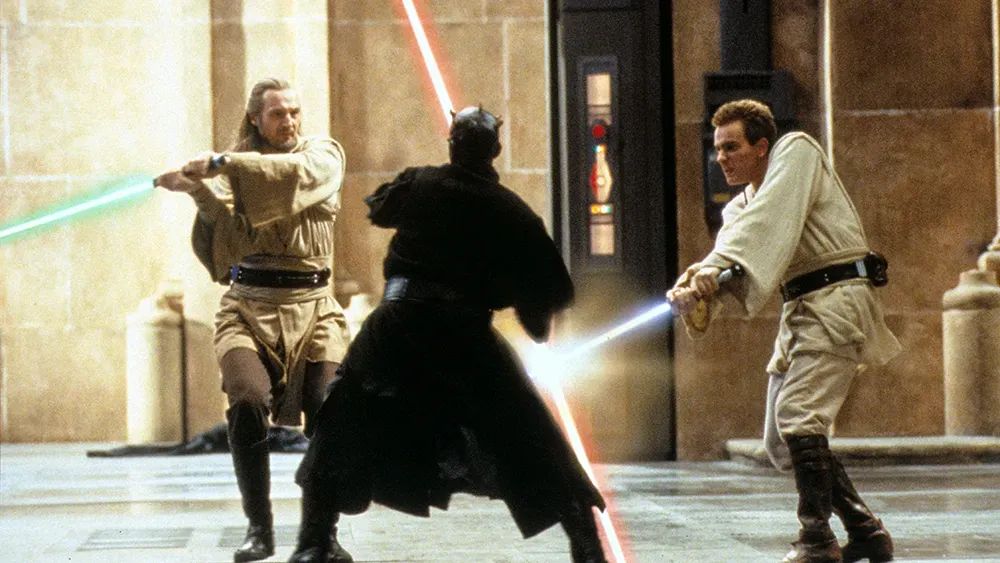
I think the best bits are the pod race, and the Duel of the Fates. The worst bits of the film are pretty much any interactions between Anakin and Padme, but this edition seems to have smoothed off those rough edges
A side note on this blog series
I'm rusty at blogging, and so whilst I write a bit and take notes whilst watching the films, I have to come back later to write about some of the other themes, so these posts may take a fair while to get made.
Also, I may come back to a post weeks or months after publication and hate what I've written, and end up changing a bunch of it, so these posts may change over time, who knows
